



Enterprise AI: Cognitive Intelligence Infrastructure From Data to Decisions
Enterprise AI: Cognitive Intelligence Infrastructure
From Data to Decisions
Enterprises, big or small, accumulate a wealth of knowledge that builds the character of that particular organization. We sometimes mistake this knowledge to be purely structured :the kind that lives in SQL or NoSQL databases. But we often overlook the data accumulated over time in the form of interactions like emails, chats, and calls, along with marketing materials, policies, product specifications, manuals, and more.
When a new employee is onboarded, it's this very data , not the structured records , that forms the basis for acclimating them to the culture and vision of the enterprise. This is the lens through which we should think about Enterprise AI: it needs to be built not only on structured data, but on the vast amount of fragmented, unstructured data that actually carries an organization's character.
A system built on all forms of available knowledge ,not just structured data ,lays the foundation for a Cognitive Intelligence Platform. This is a fundamentally different starting point than simply integrating an LLM on top of existing systems.However Enterprises face several recurring challenges: siloed data, sprawling infrastructure required to manage it, and large volumes of archived data that remain underutilized. Many enterprises also have fragmented AI or ML integrations designed to solve localized problems. While useful individually, these systems often introduce their own governance overhead and eventually become yet another piece of infrastructure to maintain.
Thereby comes the role and important of Cognitive Intelligent Platform that not only assimilates the information available across the organization, but also captures how the organization actually makes decisions - its unwritten rules, priorities, processes, and context. This prevents institutional knowledge from being lost or remaining siloed within individual departments or systems. Such a platform can become the foundation of a Cognitive Enterprise, helping the organization transition from reactive and predictive analytics to proactive, enterprise-wide reasoning and decision support.
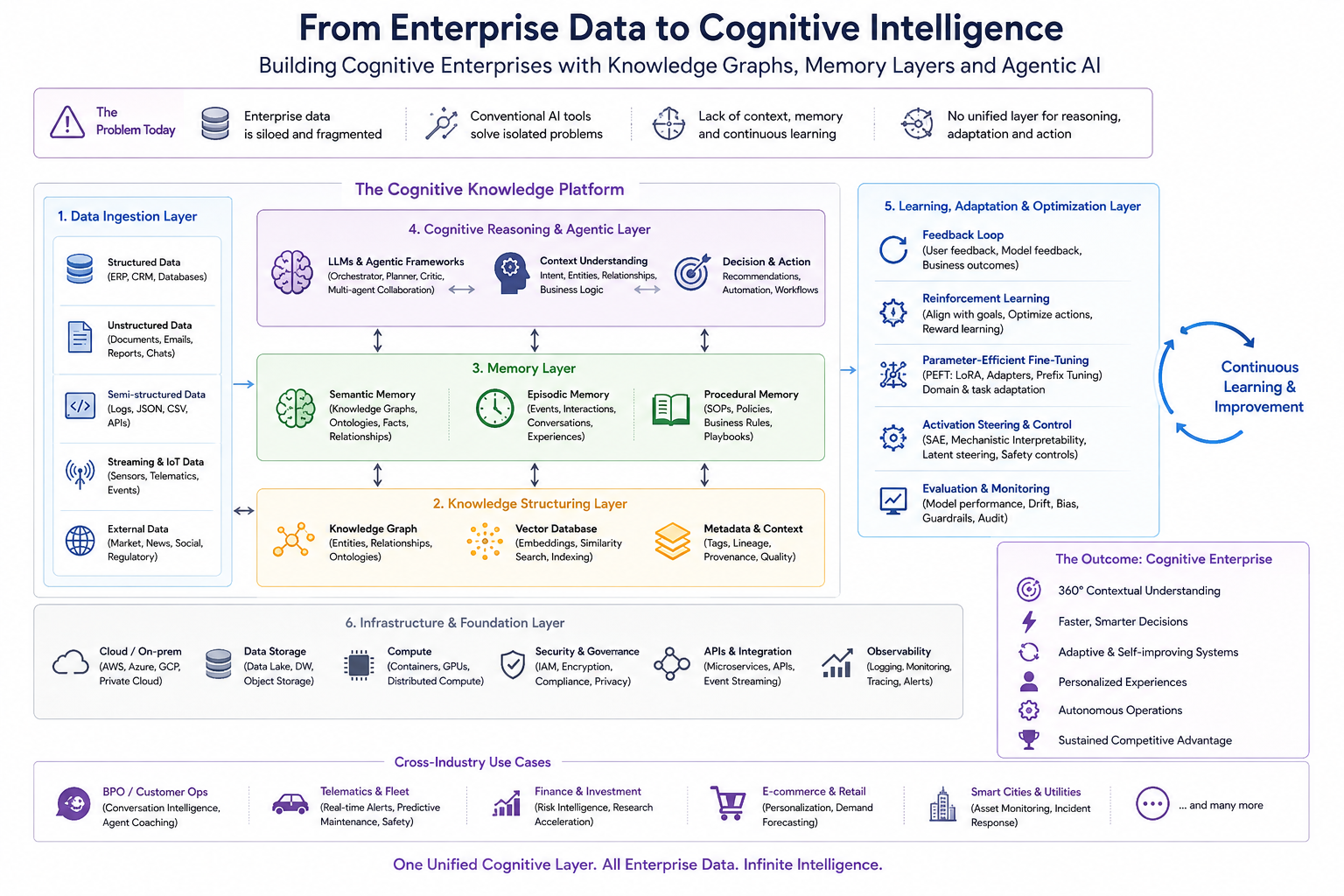
While building Enterprise AI, it is important that: a) the model functions as a representative of the company and reflects its ethos; b) the model abides by the organization's procedures, policies, and rules; and c) the system continuously learns from new information and adapts its knowledge and policies accordingly.
Every company possesses a huge amount of highly unstructured data. This may include interaction data such as emails and conversations, marketing material such as presentations, financial data, HR data, operational documents, and more. This information can be used to build a richer memory layer for an LLM - the Knowledge Layer.
Memory Layer / Knowledge Layer
The Knowledge Layer contains structured information derived from organizational data. For example, under HR policies it may include induction programs, employee benefits, leave policies, and other organizational procedures. In many cases, the Knowledge Layer can maintain structured entities, relationships, summaries, and pointers to the underlying detailed information.
Vector DB
The Vector DB stores or indexes the organization's underlying unstructured and semi-structured information in an embedding space, allowing semantically relevant information to be retrieved when needed. The Knowledge Layer can maintain links or pointers to this information.
In addition to maintaining the organization's accumulated or "tribal" knowledge, the Knowledge Layer needs to be continuously updated through day-to-day interactions. Episodic memories can be created from significant interactions and outcomes, helping the system preserve context and use prior experience in future interactions.
What is Episodic Memory?
The concept of episodic memory is inspired by cognitive science.
Episodic memory is a type of long-term, explicit memory involving the recollection of specific experiences or events. Applied to LLM-based systems, episodic memory can make the overall system more context-aware and adaptive. Consider a customer-support scenario: routine customer enquiries may be handled through standard procedures, while an interaction involving a legal or regulatory threat may be significant enough to be stored as an episode. The system can then retrieve relevant aspects of that episode when similar situations arise in the future.
What constitutes an episodic memory, and what action should follow from it, will vary from organization to organization. Several techniques can be used to identify and extract meaningful episodes. At EulersLab, we are exploring Sparse Autoencoders (SAEs) and latent-state analysis to identify unusual or significant activation patterns and trajectories that differ from previously observed organizational interactions. Such novel patterns, combined with the interaction context, outcome, and reward signals, can help determine whether an event should be retained as episodic memory. This is a simplified description of a considerably more complex process.
Procedure Memory
In cognitive science, procedural memory is associated with brain systems including the basal ganglia. It supports the execution of learned skills and habits without requiring conscious deliberation for every step.
Replicating aspects of procedural memory in LLM-based systems is particularly relevant for Enterprise AI. It can represent organizational policies, operating frameworks, and expected behaviors - for example, regulatory-compliance procedures or behavioral protocols such as de-escalation frameworks.
Both episodic and procedural memory can be developed for an enterprise using its accumulated institutional knowledge and can continue to evolve through real-time interactions, feedback, and appropriate reward mechanisms.
Worked Example to explain Knowledge Layer
Eg: A Customer Complaint Through the Cognitive Layer
The trigger: A customer emails, "This is the third time your billing system has overcharged me. I'm considering filing a complaint with the regulator."
1. Vector DB — retrieval
The system embeds the email and retrieves semantically similar past cases: prior billing-dispute threads, the refund policy document, and two earlier support transcripts with this same customer.
2. Knowledge Layer — structured context
The Knowledge Layer supplies the organizational facts around that retrieval: this customer's account tier, the current refund-authorization threshold ($500, requires manager sign-off above that), and the standard billing-dispute resolution steps.
3. Procedural Memory — how to act
Procedural memory kicks in to shape behavior, not just facts: it supplies the de-escalation protocol for regulatory-threat language — acknowledge first, don't admit fault prematurely, loop in the compliance team before promising any resolution. This is the "learned habit" layer — the model doesn't have to reason this out from scratch each time.
4. Episodic Memory — the flag
Here's where it diverges from a routine ticket. A standard billing question wouldn't get stored as an episode — it's resolved and forgotten. But the phrase "regulator" plus a third repeated incident crosses the threshold existing SAE/latent-state monitoring is watching for: an unusual pattern relative to normal billing complaints. This interaction gets tagged and stored as an episodic memory — customer, issue, resolution, and outcome — so if this customer (or a similar pattern) resurfaces in 3 months, the system already has that history instead of treating it as a fresh case.
5. LLM — the response
The model now drafts a reply grounded in all four layers: acknowledges the recurrence (Knowledge Layer facts), follows the de-escalation script (Procedural Memory), avoids over-promising (compliance policy), and flags the case for human review given the regulatory language (Episodic trigger) — rather than handling it like ticket #1 or #2.
Result: the next time this pattern appears — even with a different customer — the system has a stored episode to draw on, and the procedural memory has already been reinforced by the outcome of this one.
LLM Model
The LLM is the centerpiece of the solution. Enterprises can choose between frontier cloud models and self-hosted small or medium-sized models, depending on their requirements for reasoning capability, privacy, control, cost, customization, and infrastructure. The key advantages and trade-offs of both approaches are outlined below.
Using Frontier Cloud LLM (Claude, OpenAI, Gemini)
Pros:- Superior Reasoning Ability
- Massive Native Context Window
- Lower infrastructure overhead (apart from building and operating the Knowledge and Application Layers)
- Data Privacy & Compliance Risks
- Unpredictable Pricing
- Frequent model updates and potential deprecations
- Vendor Lock-in
Using In-House Small/Medium Models (Llama 3.1 8B/70B, Mistral, Qwen)
Pros:- Absolute Data Sovereignty
- Predictable and Scalable Costs
- Domain Customization
- Total Structural Control
- High Engineering Complexity
- Context Efficiency Limits
At EulersLab, we have been working on techniques that can help in-house models reason and act more effectively within enterprise environments. Some of the approaches we use and explore include:
1) Parameter-Efficient Fine-Tuning (PEFT):
PEFT can be thought of as a focused onboarding program that teaches a model enterprise-specific rules, terminology, behavior, and style without requiring it to relearn general language capabilities.
Techniques such as DoRA and QLoRA can adapt selected model parameters efficiently, including with quantized model weights, reducing the compute and memory requirements compared with full fine-tuning.
2) Reinforcement Learning (RL)
Reinforcement Learning (RL) is a training approach that can transform a passive language model into a more goal-directed problem solver. Rather than relying only on learned text patterns, the model can learn from task execution, automated or human-generated feedback, reward signals, and the outcomes of its actions.
3) Activation Steering
Activation steering is one of the emerging techniques in which EulersLab is actively investing research effort. Advances in mechanistic interpretability allow us to study internal model activations and examine how representations and trajectories evolve across layers in response to different inputs. This can help us understand behaviors such as refusal, bias, language choice, or other response characteristics and explore whether selected behaviors can be influenced at inference time.
One way to influence a model's behavior is through prompt context. Activation steering provides another mechanism: instead of changing only the prompt, selected internal activations can be shifted toward or away from particular learned directions. A simple illustrative example is steering language style - such as encouraging a response to remain in Hinglish rather than drifting into Hindi or English - while preserving the underlying task and context.
SUMMARY:
Enterprise AI should be viewed not as another isolated application, but as a cognitive layer that sits across the organization. Its purpose is to connect fragmented enterprise data with institutional knowledge, operating procedures, historical experience, and reasoning capabilities so that AI can respond within the organization's actual context rather than relying on generic model knowledge alone.
The proposed Cognitive Intelligence Infrastructure therefore combines a Knowledge Layer with different forms of memory, including semantic/organizational knowledge, episodic memory for significant experiences, and procedural memory for policies and repeatable behaviors. Knowledge graphs and vector databases provide complementary mechanisms for structuring relationships and retrieving detailed information, while continuous interactions and feedback allow the memory system to evolve over time.
The LLM becomes the reasoning interface over this foundation. Depending on enterprise requirements, organizations may use frontier cloud models, self-hosted models, or a hybrid architecture. For self-hosted models in particular, techniques such as PEFT, reinforcement learning, mechanistic interpretability, and activation steering can help adapt model behavior to enterprise-specific requirements. The long-term objective is to move beyond fragmented AI and conventional analytics toward an enterprise-wide cognitive platform that can understand context, retain experience, follow organizational procedures, and support increasingly proactive decision-making.
About Author


0 Comments